Flying a flag at home: the rules in England
Which flags you can fly without permission, the 4.6 m height limit that applies to some garden flagpoles, two flags on one pole, and choosing a garden or wall pole.
Checked 6 November 2026 · sources at the end
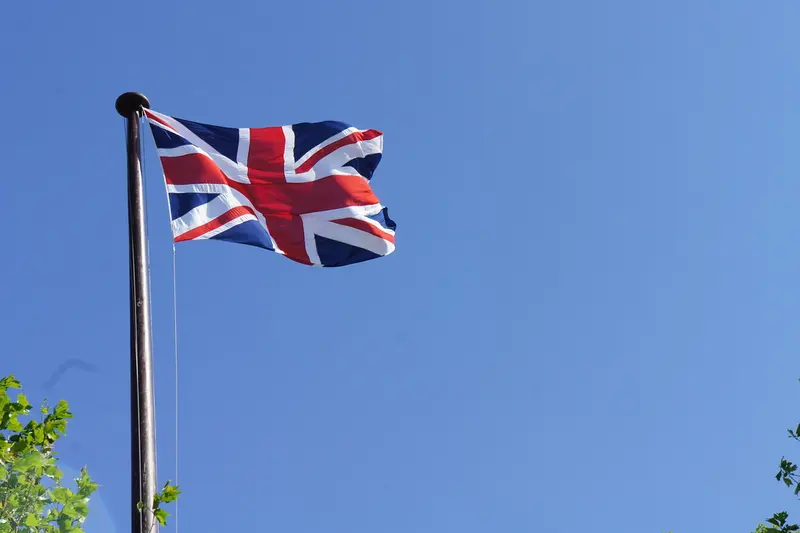
In England, flags count as advertisements for planning purposes, so the rules on flying one sit in the advertisement regulations. GOV.UK publishes a plain English guide to them, and this page summarises it for a house and garden. The guide applies to England only; elsewhere in the UK, ask your council. If you’re unsure, GOV.UK’s advice is to contact your local planning authority.
Rules for every flag
GOV.UK says all flags must:
- be kept in a condition that doesn’t spoil the look of the site;
- “be kept in a safe condition”;
- have the permission of the owner of the site (including the highway authority on highway land);
- not obscure or confuse official road, rail, waterway or aircraft signs, or make those types of transport hazardous;
- be removed carefully if the planning authority requires it.
Flags you can fly without consent
These need no consent, provided neither the flag nor its pole carries any advertising:
- any country’s national flag, civil ensign or civil air ensign (the flags of St George and St Andrew count as the national flags of England and Scotland);
- the flags of the Commonwealth, the United Nations or any international organisation the UK belongs to;
- the flag of any island, county, district, borough, burgh, parish, city, town or village in the UK, and of the Black Country, East Anglia, Wessex, any Part of Lincolnshire, any Riding of Yorkshire or any historic county;
- the flags of St David and St Patrick;
- the flag of any administrative area of a country outside the UK;
- any flag of His Majesty’s forces, and the Armed Forces Day flag.
You can attach a black mourning ribbon where the flag can’t be flown at half mast. GOV.UK notes that the EU flag is no longer on this list.
Flags with “deemed consent”
Some flags can be flown without applying, if you keep to extra limits. They include a house flag (the name, emblem or trademark of whoever occupies the building, or a short-term event there), a sports club flag (without sponsorship logos), the Rainbow flag, the NHS flag and certain award scheme flags.
The limits depend on where the pole is:
- In the grounds of the house (the regulations say “curtilage”): you can have two flagpoles, there is no limit on flag size, but “any flagpole may not exceed 4.6 metres above ground level”.
- On a pole projecting from the wall: the flag may not exceed 2 square metres.
- On a vertical pole on the roof: no limit on flag size.
In a “controlled area” — an area of outstanding natural beauty, area of special control, the Broads, a conservation area or a National Park — there are tighter limits, and a projecting or garden pole needs consent. Any flag not covered above needs express consent from the local planning authority.
Two flags on one pole
GOV.UK says two flags can share a pole without consent if both are from the no-consent list, or one is from that list and the other has deemed consent. If one of them is the Union Flag, it must be flown in the superior (top) position.
Choosing a pole
The rules shape the choice. If you might fly a house, club or Rainbow flag from a garden pole, the 4.6 m height limit applies — so check the extended height before you buy a tall telescopic garden flagpole.
For a permanent pole, UK maker Harrison Flagpoles says its most popular garden flagpole is “a 6 metre pole with a 2 yard flag”, while adding that there “isn’t really a standard”. Its garden poles come with a halyard and cleat and a ground sleeve to set the pole in. For a wall, Harrison’s angled poles use brackets at 30°, 45° or 60°, and it recommends a “Lazy Line” to stop the flag tangling around an angled pole.
Safety
GOV.UK’s standard conditions require a flag to be kept in a safe condition. Think about where the pole could land if it ever fell, follow the maker’s installation guide, and never put a flagpole anywhere near overhead power lines — HSE warns that “Touching a power line is not necessary for danger”.
See all garden flagpoles and fittings we list.
Sources
- GOV.UK: Flying flags — a plain English guide (checked 6 November 2026)
- Harrison Flagpoles: Garden flagpole information (checked 6 November 2026)
- Harrison Flagpoles: Wall mounted flagpoles (checked 6 November 2026)
- HSE: Overhead power lines (checked 6 November 2026)
Checked 6 November 2026.