Amateur radio masts: licence and planning basics
You need an Ofcom licence to transmit, and most permanent amateur aerials need planning permission. The basics, from the RSGB and the Planning Portal, with what changed in England in 2024.
Checked 6 November 2026 · sources at the end
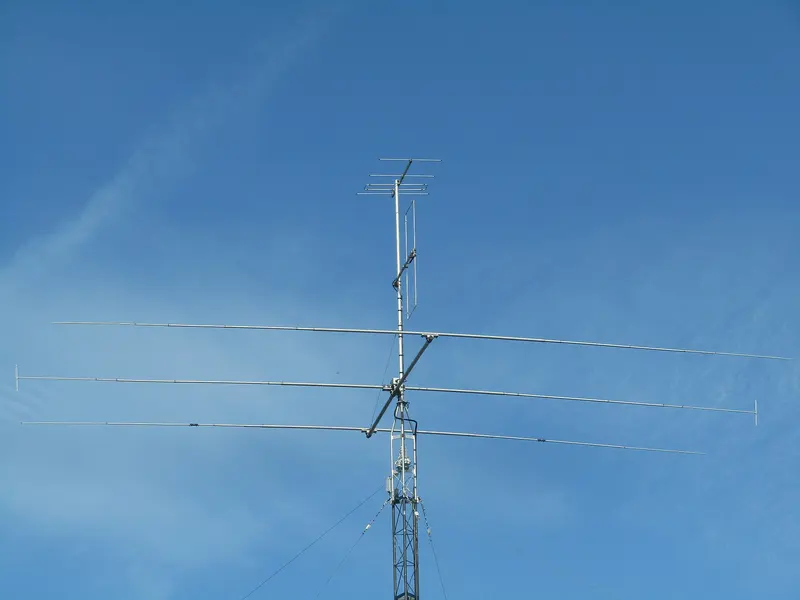
Putting up a radio mast raises two separate questions: are you allowed to transmit, and are you allowed to build the mast or aerial where you want it? The first is about your licence from Ofcom; the second is about planning law and your local council. This guide gives the basics as the Radio Society of Great Britain (RSGB) and the Planning Portal explain them. It isn’t legal advice — for a decision about your own home, ask your local planning authority.
The licence: you need one to transmit
The RSGB puts it simply: “Any one can listen to the amateur bands, but you need a licence to transmit on them.” Licences are issued by Ofcom.
- Foundation first. The RSGB says your first licence is the Foundation Licence. About 12 hours of tuition is normally needed, and the exam is “26 multiple choice questions which you have 60 minutes to answer”, usually taken online — either at home with a remote invigilator or at a club. There is a set fee for the exam, and no lower age limit.
- Applying. According to the RSGB, “Online issue/renewal for UK amateurs is free”, while postal and other applications may incur a fee.
- Keeping it. The licence is sometimes called a licence for life, but the RSGB explains that “all radio amateurs are required to revalidate their licence at least every five years” by confirming their details with Ofcom. If you don’t, Ofcom may revoke the licence.
- Recent changes. Ofcom’s current licence framework started on 21 February 2024, and further changes took effect in October 2025, including new M8/M9 Intermediate call signs and easier revalidation, according to the RSGB.
Ofcom’s own website has the licence conditions and online licensing service.
Planning: most aerials need permission
The RSGB’s planning page says: “Most amateur aerials require planning permission from the local Council.” It lists the main exceptions:
- the aerial counts as permitted development — “usually types similar to TV antennas and ground mount antennas up to three metres in height, etc. but some local councils allow more”;
- “The antenna/mast is present for less than 28 days per annum”;
- “The antenna/mast is truly mobile”.
Those exceptions are why a mast that goes up for an afternoon’s portable operating is treated differently from one fixed permanently in the garden — but check with your council if you’re unsure.
What “permitted development” covers for antennas (England)
The Planning Portal says that under the General Permitted Development Order 2015 “you have a general permission to install an antennas up to a specific size on property without the need for planning permission”, depending on your house type and area. For houses and buildings up to 15 metres high outside designated areas, it lists the limits, including:
- no more than two antennas on the property overall;
- a single antenna no more than 100 cm in any linear dimension (with two, one up to 100 cm and the other up to 60 cm);
- each antenna no more than 35 litres in volume;
- an antenna on a chimney stack no more than 60 cm in any linear dimension;
- a roof antenna only sticking up above the roof where there is a chimney stack, and then by no more than 60 cm.
“Any work which does not meet all these requirements will require planning permission.” Designated areas — conservation areas, National Parks, Areas of Outstanding Natural Beauty, the Broads and World Heritage Sites — have tighter rules, and listed buildings may need listed building consent. The Planning Portal also reminds you to check permission from your landlord or the owner.
Many amateur aerials and masts are bigger than these limits, and the RSGB’s view is that most need planning permission.
England’s enforcement time limit changed in 2024
The RSGB explains that, in England, unauthorised works on a home used to become immune from enforcement after four years. Under the Levelling-up and Regeneration Act 2023 this became ten years for installations not substantially completed by 25 April 2024. It says the four-year rule continues in Wales, Scotland and Northern Ireland, and that changing or adding antennas can restart the clock. Don’t rely on the clock — ask first.
Practical steps
- Get licensed before you transmit.
- For a permanent installation, talk to your local planning authority early.
- Check your lease, deeds or landlord for any restrictions.
- Wherever it goes, keep the mast well clear of overhead power lines — see putting up a telescopic mast safely.
The RSGB offers planning help to its members. See also our portable radio kit.
Sources
- RSGB: Becoming a radio amateur (FAQ) (checked 6 November 2026)
- RSGB: UK amateur licensing (checked 6 November 2026)
- RSGB: Ofcom implements phases 2 and 3 of the licence review (17 Oct 2025) (checked 6 November 2026)
- RSGB: Planning matters (checked 6 November 2026)
- Planning Portal: Satellite, TV and radio antenna — general information (checked 6 November 2026)
- Planning Portal: Antennas on houses and buildings up to 15 metres high (checked 6 November 2026)
Checked 6 November 2026.