Putting up a telescopic mast safely
Fibreglass and carbon telescopic poles for portable radio aerials: how they work, how to guy them, what to do on windy days, and why power lines rule out a site completely.
Checked 6 November 2026 · sources at the end
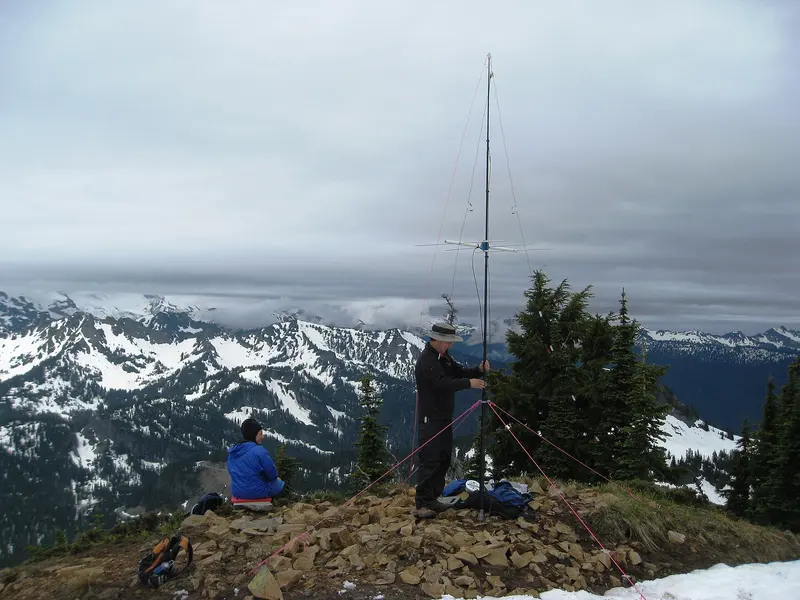
Lightweight telescopic masts — mostly fibreglass, some carbon fibre — are widely used to hold up portable amateur radio aerials. They go up in a minute and pack down small, but they bend, they can collapse, and they must never go near overhead power lines. This guide uses advice from SOTAbeams, a UK maker of portable masts, and the Health and Safety Executive (HSE).
Power lines first. HSE warns that “going close to a live overhead line can result in a flashover that may kill. Touching a power line is not necessary for danger”, and that “electricity can bypass wood, plastic or rubber, if it is damp or dirty”. Look up before you choose a spot, and keep well clear of any overhead line — including lines on wooden poles, which HSE says can be mistaken for telephone wires.
How a telescopic mast works
SOTAbeams explains that most portable masts are “re-purposed” fishing poles, extended “by pulling and twisting the sections. Friction holds the sections out.” Quality “varies widely”. Points it says to be aware of:
- the length is often “a few percent less than advertised”;
- “when used in windy conditions or for extended periods, the ‘friction lock’ may work loose causing the pole to collapse”;
- base caps are often slightly brittle.
Putting it up
- Pull and twist each section firmly. SOTAbeams says to start with the smallest section when erecting and the largest when taking down.
- For long sessions, SOTAbeams suggests taping the joints with insulating tape and putting closed-cell foam in the bottom of the largest section, so a collapse does less damage.
- Don’t over-tighten. SOTAbeams advises “keeping guys and antennas fairly slack” to minimise the downward force on the pole, and on its 10 m Travel Mast page warns: “If the pole is bending a lot, you have too much tension on it! The poles will break if bent too far.”
Guying
Anything more than a short mast needs guys. SOTAbeams’ GK10 guying kit for 8–12 m poles is an “adjustable 4-guy system” with alloy pegs, 30 m of hi-viz line, a winder and a guying ring; SOTAbeams says it “Guys our 10m SOTAPOLE at 4.7 m”. A guying collar slides down the pole to give the lines somewhere to attach — the 34 mm collar sits at 2.7 m on SOTAbeams’ Travel Mast. Fluorescent hi-viz cord makes the lines easier for other people to see.
SOTAbeams says its SOTAPOLEs “will stand a moderate wind if properly erected” — so guying properly is part of the deal, not an extra.
Windy days
SOTAbeams’ advice: “Lightweight poles will bend in the wind. Resist the temptation to tighten your antenna or guying system. Instead, move the base of the pole back so that the top of the pole is angled into the wind.” It also reminds you that “you can reduce the height of the pole”. Check the gust forecast before you go — see reading the wind.
Fibreglass or carbon?
From a radio point of view, SOTAbeams says fibreglass “does not conduct” while carbon fibre “is a conductor”, which affects how aerials can be mounted. For safety near power lines, its Carbon-6 page warns that carbon masts “are slightly conductive and so extra care must be taken when using them near power-lines”. Don’t treat a fibreglass mast as safe near a line either: HSE’s point about damp and dirty plastic applies.
If a pole breaks
SOTAbeams warns that “shards of C-G or F-G are razor sharp. Be very careful when handling a broken pole.” It notes that poles tend to break towards the middle of a section, and that a broken section can often be slid back into itself as a shorter field repair.
Bases and stands
On hard ground or beside a car, a stand saves digging. SOTAbeams’ drive-on stand is a 2.68 kg plate you park a wheel on, with a short pole the mast slides over.
Licences and planning
Transmitting needs an amateur radio licence, and a permanent mast may need planning permission. See amateur radio masts: licence and planning basics.
Quick checklist
- Look up: no overhead lines anywhere near.
- Extend from the smallest section, twisting firmly.
- Guy it, with lines slack rather than bowstring-tight.
- In wind, angle the top into the wind or lower it.
- Take it down from the largest section, carefully.
Sources
- SOTAbeams: Lightweight Antenna Masts – a few thoughts (PDF) (checked 6 November 2026)
- SOTAbeams: Compact Travel Mast 10 m (checked 6 November 2026)
- SOTAbeams: Mast Guying Kit GK10 (checked 6 November 2026)
- SOTAbeams: SOTAPOLE telescopic masts (checked 6 November 2026)
- SOTAbeams: Carbon-6 mast (checked 6 November 2026)
- SOTAbeams: Guying Collar 34 mm (checked 6 November 2026)
- HSE: Overhead power lines (checked 6 November 2026)
- Met Office: How to find wind and gust information in the Met Office app (22 Oct 2026) (checked 6 November 2026)
Checked 6 November 2026.