How to guy a tent properly
Why every guyline matters, which pegs to put on the main guys, how to keep lines tight without fiddly knots, and how to stop people tripping over them after dark.
Checked 6 November 2026 · sources at the end
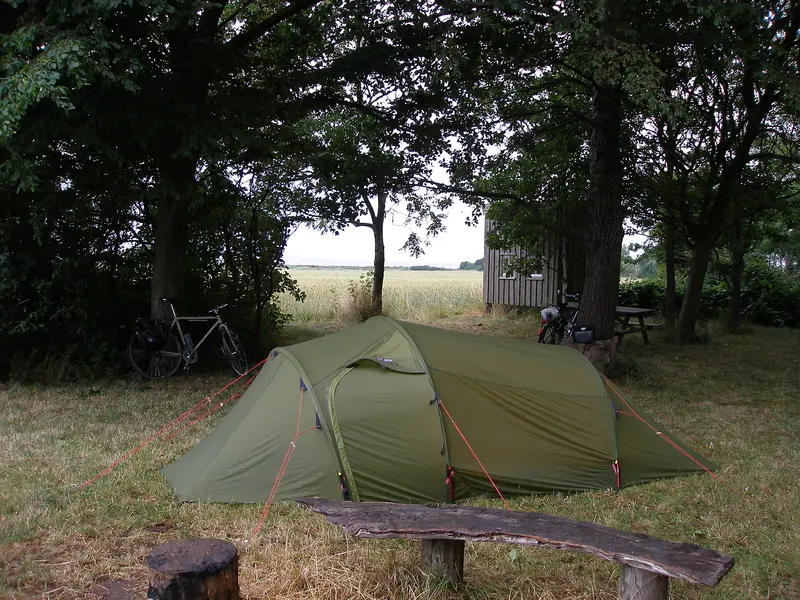
A tent is only as steady as the lines and pegs holding it down, and the makers’ advice is consistent: don’t leave the guylines in the bag because the evening looks calm. This guide brings together what tent and accessory makers say about guying a tent properly, with links to the sources at the end.
Nothing on this page makes a tent stormproof. Your tent’s own pitching instructions come first — if they show a particular layout, number of guylines or wind limit, follow them.
Peg out everything, every time
Outwell’s pegging guide puts it simply: “Always fully peg out a tent in case the weather suddenly turns.” A tent pegged only at the corners can look fine on a still afternoon, but guylines are what spread the load when the wind gets up overnight. The same guide suggests asking the site owners which pegs they recommend for their ground — they know whether you’ll hit stones a few centimetres down.
Your tent’s instructions show where each guyline goes and which are the main guys — Outwell’s guide talks about “main guys” and “side guys”, and recommends different pegs for each.
Put your best pegs on the main guys
Not all pegs are equal, and the main guys take the most load. Outwell’s guide recommends:
- big wooden stakes for main guys in soft conditions;
- metal pegs on medium to hard ground, with the V-profile “perfect for main guys” and the U-profile for general guylines;
- rock pegs such as its Tarzan Rock on stony ground;
- Delta pegs for “all-weather security” on main and side guys.
Delta Ground Anchors itself says its yellow pegs are “For use with the main supporting guys on all tents and awnings”. Our pegs guide goes through each kind of ground in more detail.
Always drive pegs with a mallet rather than your boot or a stone — Outwell recommends a mallet “to prevent accidents” — and use a peg extractor to get them out again.
Getting the tension right
A guyline needs to be tight enough to keep the fabric taut without dragging the tent out of shape. Many tents have runners (small sliders) on each line so you can tighten it after the peg is in. If yours are worn or missing, makers sell replacements — Outwell, for example, sells packs of Rapid Guyline Adjusters for its tents with 4 mm guylines.
There are two other ways to keep a line tight:
- A friction knot. Outwell’s knots guide shows the Tarbuck knot, which it describes as “an easy way to adjust the tension in a tent or tarp guyline”. It notes that two turns are quicker but three “will grip better if large loads are expected”.
- A tightener. Nite Ize’s Figure 9 and CamJam fittings let you pull a line tight and lock it without tying a knot. The Figure 9 Reflective Tent Line Kit pairs four of them with reflective cords. Check the load limits: Nite Ize gives 22.5 kg for the small Figure 9 carabiner and 67.5 kg for the large, and says not to exceed the limit of the product or the rope, “whichever is less”.
It’s worth walking round and checking the tension again after rain and before you turn in for the night.
Spreading the load: a windbreak example
Tent layouts vary too much for one rule, but windbreaks show the idea clearly. Vango’s instructions for its Family Windbreak say to put two guy ropes on each end pole and “peg out at around 90 degrees from each other”, then peg out the middle uprights, and in some conditions to “stagger the central guylines on either side of the windbreak, for stability.” They also carry a plain warning: “The windbreak is not designed for very high wind speeds or very exposed campsites.”
Keep an eye on the forecast
The Met Office points out that gusts — brief increases in wind speed — “can be considerably stronger than the more sustained wind between them”. When you check a forecast, look at the gust figure as well as the average wind speed. Our guide to reading the wind explains the Beaufort scale and where to find gust forecasts.
Stop the trip hazards
Guylines are hard to see at night. Outwell says its luminous guylines make it “easy for you to see the guylines and thus move safely around the tent – even after dark”, and Vango’s Groundbreaker Glow pegs have reflective caps that it says “can reduce the risk of trips”. Reflective cord such as the Nite Ize kit works the same way when a torch catches it. You can browse reflective guy ropes on Amazon or see our guy ropes and cord.
Packing up
Use a peg extractor rather than pulling on the guyline. Outwell’s tips finish with a reminder to clean and repair your pegs when you get home, replace any that are missing, and store them separately so they don’t damage the tent fabric.
Quick checklist
- Read your tent’s pitching instructions and note any wind limit.
- Pitch the body, then the main guys, then the side guys — every one.
- Use the right pegs for the ground, with the strongest on the main guys.
- Tension evenly with runners, a Tarbuck knot or a tightener.
- Re-check after rain and before dark; make lines visible.
As an Amazon Associate we earn from qualifying purchases.
Sources
- Outwell: Tent pegging guide (checked 6 November 2026)
- Outwell: Knots for camping (checked 6 November 2026)
- Nite Ize: Figure 9 Reflective Tent Line Kit (checked 6 November 2026)
- Nite Ize: Figure 9 Carabiner Rope Tightener (checked 6 November 2026)
- Vango: Family Windbreak pitching instructions (PDF) (checked 6 November 2026)
- Vango: Groundbreaker Glow Peg Set (checked 6 November 2026)
- Outwell: Luminous Guyline (checked 6 November 2026)
- Delta Ground Anchors: home page (checked 6 November 2026)
- Met Office: How to find wind and gust information in the Met Office app (22 Oct 2026) (checked 6 November 2026)
Checked 6 November 2026.